
What happens when two of Central Massachusetts’ premier human service organizations come together?
When Alternatives Unlimited, Inc. and The Bridge of Central Massachusetts affiliated on July 1, 2018 as Open Sky Community Services, it meant the best of both worlds for the individuals our two agencies served. Both organizations were well respected for their decades of experience in program development and were known for innovative services. While The Bridge was recognized for its leadership in the implementation of evidence-based practices, Alternatives focused on psychiatric rehabilitation and the importance of community inclusion for individuals served by the agency. By coming together, we have been able to utilize the diverse, but complementary strengths both organizations brought to this new venture to support the people we serve in finding the success they need and deserve.
We look forward to a long and successful history of our own, but want to honor the history that each of the two storied agencies brought with them to this new and exciting venture.
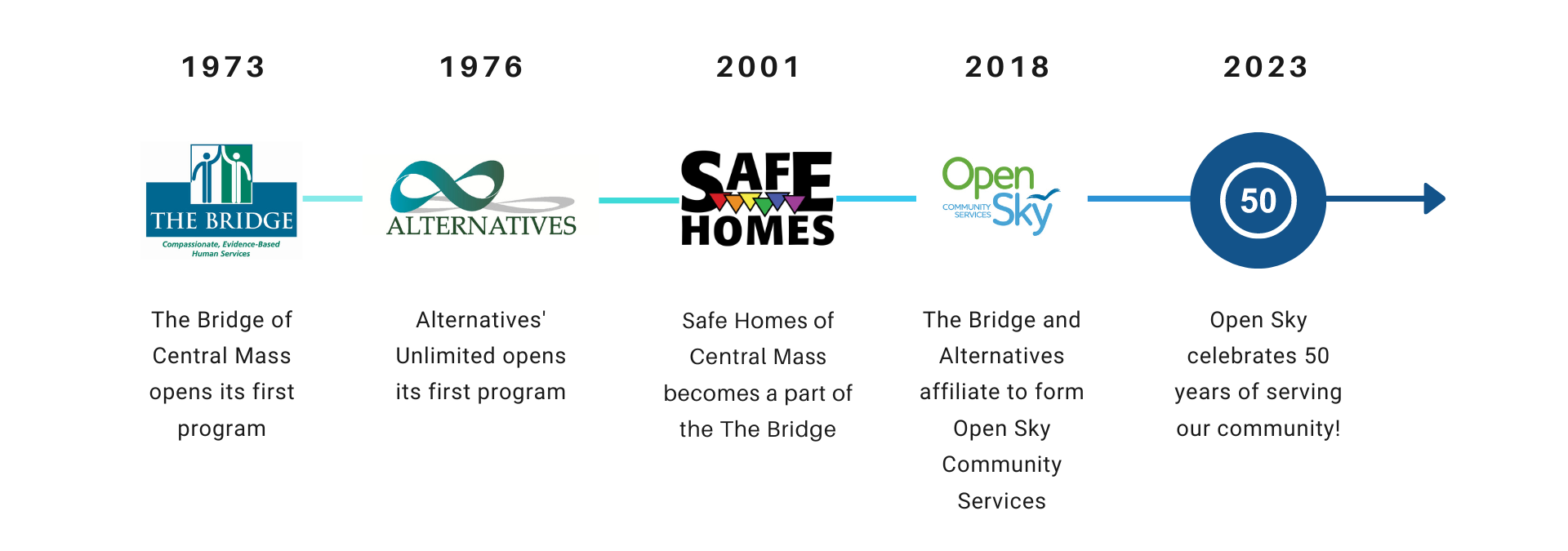 View the Full Timeline of Our History
The History of Alternatives
The history of Alternatives encompasses more than 40 years of Building Stronger, More Inclusive Communities.
In 1976, Alternatives was a three-program agency with 15 employees serving 26 people. At the time of the agency's affiliation with The Bridge, it operated 60 different programs with a $40 million dollar annual budget. On any given day, the organization served about 1,500 individuals with disabilities.
From the agency's founding in Uxbridge, it evolved into a major provider of services throughout the Blackstone Valley as well as the Greater Worcester, Greater Milford, Fitchburg/Leominster, and Wrentham/Plainville areas.
Many Alternatives staff members were with the organization since its early years, facing the challenges of growth with an unwavering commitment to people served. A point of pride for Alternatives was the agency's record of integrating people with disabilities into the community by giving them the skills and support needed to achieve success.
To learn more about the Whitin Mill redevelopment and history, visit our Whitin Mill page.
The History of The Bridge of Central MA
In 1973, The Bridge opened a group home on Grove Street in Westborough to provide a "bridge" to the community for boys leaving the Lyman School. This residential program was established and operated by a group of Westborough citizens.
At the same time, another group of concerned clinicians had established an afterschool program for adolescent patients at Worcester State Hospital. This group became known as Community Treatment Center (CTC) and was led by Barry Walsh, Ph.D., among others.
In 1997, CTC and The Bridge merged to become The Bridge of Central Massachusetts. In 2003, the Bridge moved its headquarters to Worcester's Tatnuck Neighborhood. By 2018, The Bridge had over 50 programs in 17 communities throughout Central Mass, Metro-West and Boston.